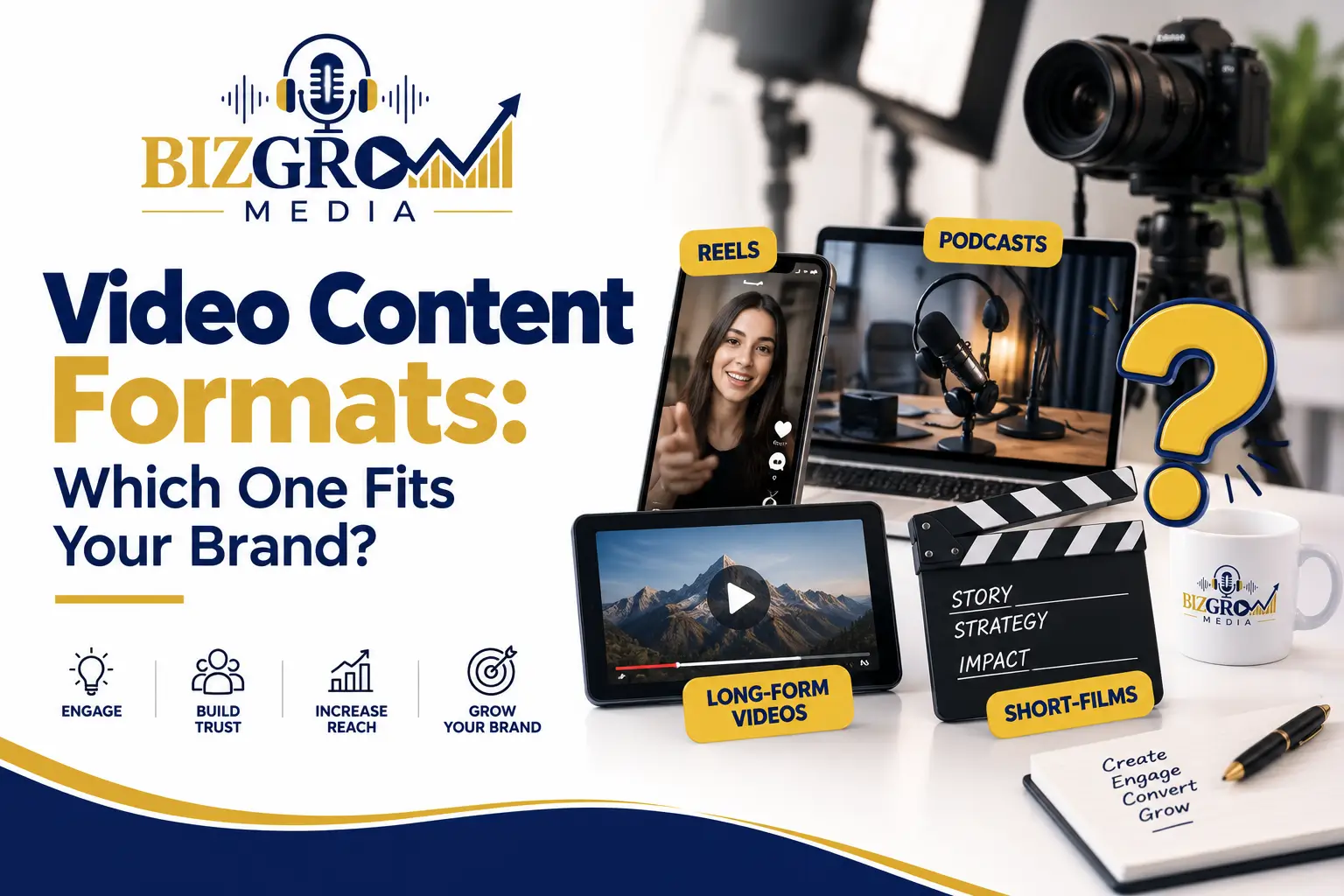
Most brands jump into video without thinking about shape. They film something, post it, and hope. Then a week later they’re confused why one clip did brilliantly and the next one barely got seen. Usually the issue isn’t the idea. It’s the format.
There’s a real difference between the kind of video that grabs someone mid-scroll and the kind that earns their trust over ten minutes. Get that difference wrong and even good content underperforms. This guide runs through the main video formats brands use, why the choice actually matters, and how to work out what fits yours.
What Are Video Content Formats
A video format is basically the shape a message takes. Fifteen seconds is one shape. A twenty-minute breakdown is another. A podcast episode is something else entirely.
Length, pacing, and purpose all shift depending on the format. Some are built to be seen by strangers fast. Others are built to hold someone’s attention long enough to earn their trust. Neither is “better” on its own they just do different jobs.
Brands that treat every video the same way tend to struggle. A punchy hook that works in three seconds falls flat stretched over ten minutes. And a slow, detailed story doesn’t survive being cut down to fifteen. Once you understand what each format is actually for, using video gets a lot easier.
Why Choosing the Right Video Format Matters
Pick the wrong format and even a great idea can disappear without a trace. That’s the risk most brands don’t think about until it’s already happened.
A few reasons the choice matters:
- Attention spans aren’t the same on every platform
- Different goals need different formats awareness isn’t the same job as education
- Audiences have habits, and some scroll while others sit and watch
- Platforms themselves reward certain formats over others
Short-form is having a real moment right now. It’s widely seen as the most engaging type of content, and its reach keeps climbing across nearly every platform. That doesn’t mean it’s always the answer though. It means brands need to actually understand what each format does well, then use it where it fits.
Get the format right and your content does more with the same effort. Get it wrong, and good ideas just quietly vanish.
The Most Popular Video Content Formats
There’s no single “correct” format. Most brands that get real results end up using a mix, depending on the platform and what they’re trying to achieve that week.
Short-Form Videos: Quick Content, Big Reach
Short-form videos are the quick clips usually under 90 seconds built for Reels, TikTok, and YouTube Shorts, where the feed never really stops moving.
Viewers decide within a few seconds whether to keep watching, so these clips have to earn attention almost immediately. Done well, they spread fast and reach people who’ve never come across the brand before. That reach is genuinely valuable.
What short-form can’t do is go deep. Try explaining something complicated in thirty seconds and it usually falls apart. It’s brilliant for a quick tip, a teaser, a flash of behind-the-scenes energy. It’s not the place for detailed storytelling.
Good for brand awareness, quick tips, and reaching cold audiences fast. Not so good for anything that needs proper explaining.
Long-Form Videos: Build Trust through Depth
Long-form runs from a few minutes up to well over ten, usually on YouTube or a website, where people arrive with a bit more patience.
There’s something short clips just can’t replicate: trust built over time. When a brand actually takes the time to explain something properly, answer the obvious questions, walk through the “why” people notice. It reads as expertise, not a pitch.
There’s a search benefit too. Google tends to favour pages where people stick around, and long-form video is one of the easiest ways to increase that time on page.
The catch is effort. Long-form takes more planning and more editing, and it still needs a strong opening or people drop off before the useful part even arrives.
Podcasts: Turn Conversations into Valuable Content
Podcasts have become one of the most underrated formats a brand can use. They’re not scripted or polished the way most video content is, and that’s exactly why people trust them.
For founders especially, a podcast gives room to actually explain how you think, not just deliver a headline. And practically speaking, one episode can be cut into dozens of clips, quotes, and posts making it one of the most efficient formats out there for long-term content.
There’s also a loyalty effect. People who listen to a podcast regularly tend to come back week after week. That kind of habit is hard to build with short clips alone.
Explainer Videos: Make Complex Ideas Simple
An explainer video has one job: take something confusing and make it clear. How a product works, what a service actually includes, how a process unfolds usually with simple visuals or a walkthrough.
It removes friction. Instead of a customer wading through pages of text trying to work out what you actually do, a two-minute video does it faster and sticks better.
These tend to sit well on landing pages and product pages, right where confusion usually causes people to leave without buying.
Behind-the-Scenes Videos: Show the People behind Your Brand
This is the pulled-back-curtain format the team, the process, the ordinary moments that never make it into a polished ad.
- Puts real people in front of the camera, not just the brand
- Builds familiarity without trying too hard
- Performs particularly well on Instagram and TikTok
- Feels honest rather than staged
People don’t just buy a product. They buy a bit of trust in whoever’s behind it, and behind-the-scenes content builds that quietly, without ever feeling like a sales pitch.
Educational Videos: Share Knowledge That Builds Authority
Educational content teaches something a tip, a skill, an insight worth having. Unlike an explainer, it’s usually not about your product specifically, but about the wider space you work in.
Over time, this is what turns a brand into a source people trust rather than just another seller. And unlike a lot of content, it has staying power people save it, share it, come back to it months later.
Promotional Videos: Turn Attention into Action
Promotional videos have one job get someone to actually do something. Book a call, buy something, sign up.
They work best once some trust already exists. Show a promo to a cold audience and it usually gets scrolled past. Show it to people who already know the brand through other content, and it converts far better.
The strongest promotional videos stay focused on one action. Try to promote three things at once and the whole thing weakens.
How to Choose the Right Video Format for Your Brand
With this many options, picking one can feel like guesswork. It usually isn’t. It comes down to two fairly simple questions.
What Type of Content Does Your Audience Actually Want?
Every audience behaves a bit differently. Some want something quick they can watch on the bus. Others sit down properly for a longer video that actually teaches them something.
Look at what your audience already does. Which format gets more comments, more shares, more saves? That existing behaviour usually tells you more than any guide can.
Which Video Format Works Best for Your Business Goals?
Format should follow the goal, not the other way round.
- Awareness → short-form video
- Trust and authority → long-form video or podcasts
- Reducing confusion → explainer videos
- Humanising the brand → behind-the-scenes content
- Driving a direct action → promotional videos
Trying to make one format do every job at once rarely works? Matching format to purpose makes each video pull its own weight.
How to Create More Content from One Video
One of the smartest habits a brand can build is repurposing. A single long-form video or podcast episode can be broken down into short clips, pulled quotes, captions, even a full blog post.
It saves time, keeps output consistent, and stretches the value of one recording session much further than most brands realise. Instead of starting from scratch every week, you’re reshaping what already exists.
This is actually where a lot of brands get stuck weighing up Reels vs Podcasts, as if it has to be one or the other. In practice, the strongest brands use both the podcast becomes the raw material, and the Reels are what carries it further.
Why Your Brand Needs a Consistent Video Content Strategy
Posting when you remember to isn’t a strategy. One great video might do well once. A consistent one builds recognition the kind where people start to recognise your brand before they even finish reading the caption.
Consistency also feeds the algorithm the right signal. Irregular posting confuses both platforms and audiences. Brands that show up reliably tend to outperform brands chasing one lucky viral moment, even when the viral one technically got more views.
A real plan also removes the last-minute scramble. You know what you’re filming, when it’s going out, and how it fits the bigger picture. Cost is usually the first thing brands worry about when they think about keeping this up long-term but a good repurposing strategy keeps that concern smaller than most expect.
How BizGrow Media Helps Brands Create Better Video Content
This is where we come in. At BizGrow Media, we help UK brands turn video confusion into something that actually runs on its own no more guessing what to post next.
Our Studio & Production service handles the filming itself, built around what the brand actually needs. From there, our Content Engine reshapes that raw footage into short clips, longer pieces, and everything between, so nothing gets wasted.
Podcasts are something we genuinely care about, because we’ve watched one good conversation turn into weeks of usable content. Our Authority Builder service leans on podcasts and long-form video specifically to build real industry trust, not just quick views. And our Growth Engine ties the whole thing together, making sure the content is actually moving the business forward, not just racking up numbers that look nice.
If you’re still not sure which format fits your brand, BizGrow Media can help you work it out.
Frequently Asked Questions
What are the main types of video content?
The main types include short-form videos, long-form videos, podcasts, explainer videos, behind-the-scenes content, educational videos, and promotional videos.
Which video format is best for small businesses?
Short-form video usually works best for small businesses starting out. It’s quick to produce and reaches new audiences fast.
Are short-form videos better than long-form videos?
Not necessarily. Short-form builds reach, while long-form builds trust. Most brands benefit from using both together.
How do I choose the right video format for my brand?
Look at your audience’s habits and your specific goal. Match the format to what you’re actually trying to achieve.
Can one video be turned into multiple content formats?
Yes. A single long video or podcast can be cut into clips, quotes, and posts, stretching its value across platforms.