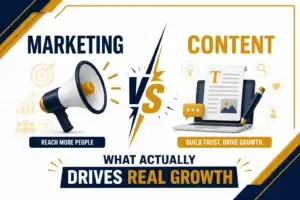
Every business owner faces the same question eventually. Should you spend more on marketing? Or should you focus on your content first? This marketing vs content debate confuses far too many businesses, since both terms often get used interchangeably. Because the real difference so often gets lost, businesses end up spending money without understanding what actually needs fixing. This guide breaks down marketing vs content clearly, explaining what each one actually does, how they connect, and why understanding this difference ultimately determines whether your business grows steadily or stalls completely, regardless of budget size.
What Is Marketing?
Marketing covers the tools and channels you use to reach people. Essentially, it amplifies a message, putting that message in front of more eyes, often very quickly depending on budget and targeting.
- Ads – Paid placements that put your message in front of a targeted audience
- Campaigns – Structured efforts built around a specific goal or timeframe
- Social media promotion – Organic and paid content shared across platforms
- Paid boosts – Extra spend to increase reach on existing posts
Because marketing focuses on distribution, it doesn’t create the message itself. Instead, it pushes existing content further, whatever that content happens to be. A marketing campaign can target the right audience perfectly, reach the ideal demographic, and still fall flat. That’s because it depends entirely on what it’s actually promoting underneath the strategy.
What Is Content?
Content is the actual message. It’s the blog post, the video, the caption, the visual. Content carries your value, your expertise, and your brand voice, giving your business an identity beyond just a logo or product.
Unlike marketing, content isn’t just about visibility. It’s about substance:
- Answers a real question – Content that genuinely helps, rather than fills space
- Solves an actual problem – Speaks to something your audience actually struggles with
- Speaks to a specific audience – Rather than trying to appeal to absolutely everyone
- Reflects your brand voice – Stays consistent, recognisable, and authentic across platforms
When you compare marketing vs content, this distinction matters enormously. Marketing decides who sees your message. Content decides whether that message actually works once it’s seen, converting attention into genuine interest.
Marketing vs Content: Why the Difference Gets Confused
Many businesses treat marketing vs content as the same thing. So they jump straight into ad spend without questioning their actual message first.
| Marketing | Content | |
|---|---|---|
| What it is | Tools and channels used to reach people | The actual message being shared |
| Feels like | Immediate, visible action | Slower, more reflective work |
| Common question asked | Which platform or hashtags work best? | What problem does this actually solve? |
| Where businesses invest first | Usually here | Often neglected |
| What it actually controls | Who sees the message | Whether the message works once seen |
Businesses often place tactics ahead of strategy. They ask which platform to use, or which hashtags work best. But they skip a more important question: what problem does our content actually solve? Because marketing feels more tangible, businesses gravitate toward it first. Spending on an ad feels like immediate action. Building genuinely strong content, meanwhile, takes more time and reflection. As a result, many businesses invest heavily in the visible half of marketing vs content, while neglecting the half that actually matters most.
How Marketing and Content Work Together
Marketing and content aren’t rivals. They’re partners but only when the order is right.
Content comes first. Marketing comes second. Here’s why:
- Strong content gives marketing something worth promoting
- Weak content leaves marketing with nothing, no matter how good the targeting is
- Good content means every pound spent works harder
- Bad content means you’re paying to expose a problem, not solve it
So, in the marketing vs content debate, content always wins the first spot.
Once your content actually works, marketing multiplies it. Here’s how:
- Ads bring more eyes to a message that already connects
- Social media spreads a story people already want to hear
- Paid promotion boosts content that’s already earning trust
- Marketing tools simply amplify what’s already working
This is the real answer to marketing vs content: it’s not a competition. It’s teamwork. Content builds the foundation. Marketing builds the reach.
The Expensive Mistake Businesses Make
Many businesses assume bigger ad budgets solve growth problems. So they increase spend, hoping different numbers produce different results. Companies without a documented marketing strategy waste an average of $847,000 annually on tactical activities that generate impressive vanity metrics but fail to drive revenue growth. That’s a significant, avoidable loss. It happens because businesses focus on marketing spend, without first fixing their content. Because marketing only pushes content further, weak messaging doesn’t improve once more people see it. It simply reaches more people who still don’t care. This is the core problem within marketing vs content thinking: treating distribution as a fix for substance.
What Happens When You Boost Weak Content
Boosting weak content follows a predictable pattern. Impressions increase immediately. Engagement, however, stays flat. Interest then fades just as quickly as it appeared. Many businesses see a spike in interest that quickly drops off, and that drop-off often discourages them into believing their content strategy failed. In reality, the spike was rented attention. Once ad spend stopped, so did the visibility. Because paid reach doesn’t build lasting trust alone, businesses often pay repeatedly for the same short-lived attention. This cycle rarely leads anywhere sustainable, since it never resolves the actual marketing vs content imbalance underneath.
Why Ad Spend Can’t Replace Real Content
Ads put your business in front of people. However, they can’t make people care once they arrive. This distinction sits at the heart of the entire ads marketing vs content conversation.
The Channel Overload Problem
B2B companies now engage across an average of 11 marketing channels. Yet, 73% report difficulty connecting channel activity to actual revenue outcomes. This gap usually exists for one simple reason: the message running through those channels doesn’t land properly.
Reach Without Substance Falls Flat
Without a clear, relevant message, even perfectly targeted ads simply introduce more people to content that doesn’t move them. So, more reach doesn’t fix a weak message. It just multiplies the exposure to the problem.
The Real Issue Isn’t Reach
The real issue was never about reach. It was always about substance. Therefore, before increasing ad spend, businesses need to fix the message first.
Signs Content Is Holding Your Marketing Back
Several warning signs suggest content, not marketing spend, sits at the root of poor results.
- High impressions, low engagement: People see your content but don’t interact with it
- Traffic that doesn’t convert: Visitors arrive but leave without taking action
- Generic messaging: Content could belong to any competitor, not specifically your brand
- Inconsistent posting: No clear theme or direction across platforms
- Ads that only work while running: Once spend stops, all momentum disappears too
If these signs sound familiar, increasing ad budget won’t fix the underlying issue. It will only spend more money exposing it further. This is exactly why understanding marketing vs content matters before adjusting any budget.
What Strong Content Actually Looks Like
Strong content shares a few consistent qualities, regardless of industry or platform. It speaks directly to a specific audience, rather than trying to appeal to everyone at once. It solves a real problem, rather than existing purely to fill a content calendar. Only 49% of businesses consider their own content marketing effective, largely due to common, avoidable pitfalls. Strong content avoids these pitfalls by starting with clarity and purpose, not just consistent posting for its own sake.
Which One Should You Focus On First?
If you’re weighing marketing vs content for your own business, the answer stays fairly clear. Content should come first, always. Building strong content doesn’t mean ignoring marketing altogether. Instead, it means establishing your message before amplifying it. Once your content genuinely connects with your audience, marketing becomes far more effective, since it’s no longer trying to sell something unclear or forgettable. Businesses that get marketing vs content backwards often burn through budget quickly, without understanding why results never arrive. Businesses that get the order right build momentum that actually compounds over time.
How BizGrow Media Helps You Get Both Right
At BizGrow Media, we help businesses solve the real problem behind marketing vs content confusion. Rather than jumping straight into ads, our Content Engine service starts with strategy, direction, and a clear brand message first.
We help you get both right by:
- Refining your brand voice, so your message actually lands
- Creating polished content across social media, video, and copy
- Building a consistent system, so you never rely on rushed, last-minute posting again
- Making sure your strategy comes before your spend, not after
Because when your content is strong, every pound spent on marketing works harder, rather than simply reaching further. Visit BizGrow Media to find out how we can help turn your ideas into content that actually performs.
Frequently Asked Questions
1. What’s the real difference in marketing vs content?
Marketing amplifies a message. Content creates that message. One drives reach, while the other drives connection.
2. Can good marketing fix bad content?
No. Marketing increases visibility, but it can’t make a weak message more convincing or relevant to your audience.
3. Should I invest in content or marketing first?
Content first. Strong messaging gives marketing spend something worth amplifying, rather than exposing a weak foundation.
4. Why does my marketing spend feel wasted?
Often the content itself lacks clarity. Marketing simply exposes more people to that same unclear message.
5. How do marketing and content work together for growth?
Content builds the message. Marketing spreads it further. Together, they create sustainable, compounding growth over time.
Conclusion
Marketing vs content isn’t really a competition. It’s a sequence. Content builds the foundation. Marketing then builds on top of it. Businesses that understand this stop wasting budget on amplifying weak messages. Instead, they build genuine substance first, then let marketing do what it does best: spread something worth spreading. Getting this order right changes everything. Your ad spend works harder. Your message actually lands. Every brand grows with real substance behind it, not just louder noise. So, before increasing your ad budget, take a step back. Ask whether your content is truly worth amplifying. If it isn’t, fix that first. If you want content that genuinely deserves the marketing spend behind it, BizGrow Media is here to help.