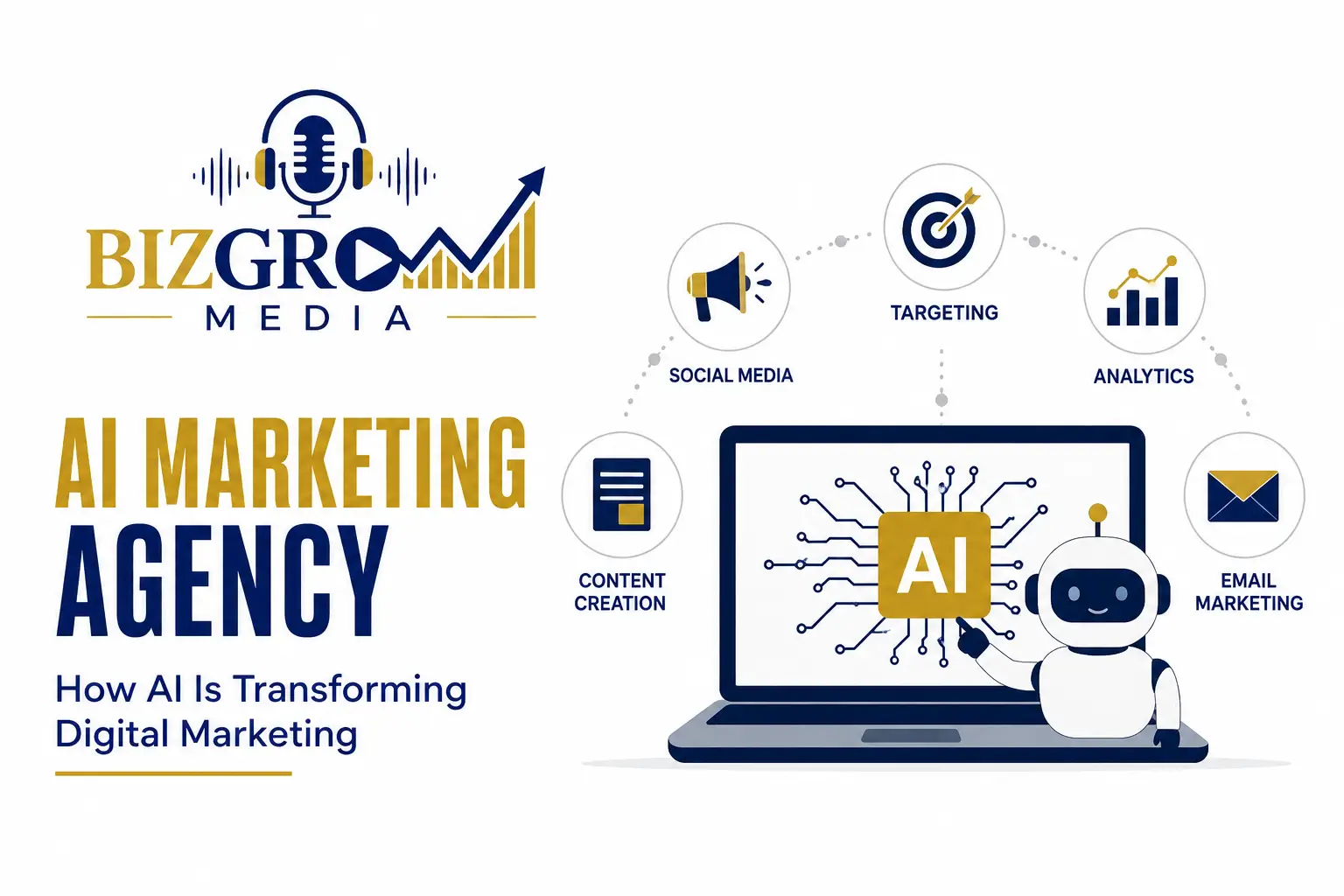
Marketing budgets have never stretched further, and teams have never had less time. Roughly 8 in 10 marketers now use some form of AI in their day-to-day work, and most say it hands them back several hours a week they used to lose to repetitive tasks. That shift hasn’t just changed how marketers work it has changed what businesses expect from the agencies they hire.
If you’ve noticed competitors publishing more, ranking faster, or responding to trends before you even spot them, there’s a good chance AI is part of the reason. Here’s what’s actually changed, and what it means for how you market your business.
What Is an AI Marketing Agency?
An AI marketing agency uses artificial intelligence tools alongside human strategy to plan, create, and optimise marketing campaigns. That doesn’t mean a computer is running the show. It means AI handles the heavy lifting data analysis, content drafts, pattern spotting, performance tracking while people still make the calls that matter: brand voice, positioning, and the bigger picture strategy.
The agencies doing this well aren’t replacing marketers with software. They’re using AI to get more out of the marketers they already have, so campaigns move faster without losing quality.
Why Businesses Are Turning to AI Marketing
The honest answer is speed and cost. A small business that used to wait two weeks for a content calendar can now have one drafted, reviewed, and scheduled in a fraction of that time. Larger companies use AI to run more campaigns at once without hiring a bigger team for every new channel.
There’s also the competition factor. Once a handful of businesses in an industry start using AI to move faster, everyone else feels the pressure to catch up. Sitting it out isn’t really neutral anymore it usually means falling behind on speed and visibility while your competitors close the gap.
That said, businesses aren’t turning to AI because it’s trendy. They’re turning to it because the return is measurable: faster turnaround, more consistent output, and campaigns that adjust based on real performance data instead of guesswork.
The Role of AI in SEO and Search Visibility
Search has changed more in the past two years than in the decade before it. AI tools now help identify what people are actually searching for, which topics are worth targeting, and where a website is losing visibility before it shows up as a ranking drop.
A few specific ways AI supports SEO:
- Spotting keyword and content gaps faster than manual research allows
- Flagging technical issues (slow pages, broken links, poor structure) before they hurt rankings
- Analysing competitor content to find what’s missing from your own
- Helping structure content so it performs well in both traditional search and AI-generated answers
None of this replaces good writing or a real content strategy. It just means less time is spent guessing and more time is spent on what actually moves rankings.
How AI Helps Businesses Understand Their Audience
Every business thinks it knows its audience until the data says otherwise. AI tools can process customer behaviour, engagement patterns, and buying signals at a scale no person could manually track, then turn that into something usable: who’s actually engaging, what content they respond to, and when they’re most likely to take action.
This is where a lot of businesses start seeing real value. Instead of sending the same message to everyone, campaigns can be shaped around what different audience segments actually care about. The result tends to be simple: fewer wasted impressions, and messaging that lands with the people it’s meant for.
AI Marketing vs Traditional Digital Marketing
Traditional marketing still works it’s built on strategy, creativity, and understanding people, and none of that goes away. What’s changed is how much manual effort it used to take to execute that strategy well.
Where traditional marketing relies heavily on manual research, scheduled reporting, and slower testing cycles, AI-supported marketing shortens all three. Campaigns get built on live data instead of last quarter’s report. A/B testing happens continuously instead of once a month. Content gets produced at a pace that used to require a much bigger team.
The businesses getting the best results right now aren’t choosing one over the other. They’re combining human judgement with AI’s speed using AI to handle the volume and pace, while people keep the strategy grounded and the brand voice consistent.
How to Choose the Right AI Marketing Agency
Not every agency claiming to “use AI” is actually using it well. A few things worth checking before you commit:
- Ask what’s actually AI-powered. Some agencies use one AI tool for scheduling and call the whole service “AI marketing.” Ask specifically what parts of your campaign involve AI, and what stays human-led.
- Look for a content system, not just content. One-off posts don’t build a brand. You want an agency with a structured process for research, creation, and consistent output.
- Check how they measure results. AI-driven marketing should come with better data, not vaguer reporting. If they can’t explain what’s working and why, that’s a red flag.
- Make sure your brand voice stays yours. AI can speed up production, but your content should never sound generic. If everything they produce could belong to any business, keep looking.
This is exactly the gap BizGrow Media’s Content Engine was built to close. It combines AI-supported research and content production with human strategy and editing, so businesses get consistent, high-quality content at a pace that manual production alone can’t match without losing the voice that makes their brand recognisable in the first place.
Choosing the right partner comes down to one question: are they using AI to genuinely improve your marketing, or just to produce more of it faster? The first builds a brand. The second just adds noise.
Final Thoughts on AI Marketing and Business Growth
AI hasn’t replaced marketing it’s changed the pace it moves at. Businesses that pair AI’s speed with real strategy are pulling ahead, not because they’re doing something entirely new, but because they’re doing the fundamentals faster and with better data behind every decision. The businesses that treat AI as a shortcut for lazy content will fall behind the ones treating it as infrastructure for smarter, more consistent marketing.
Frequently Asked Questions
Is AI marketing only for large businesses? No. Small businesses often benefit the most, since AI tools let a small team produce and manage campaigns that would normally need a much bigger budget.
Will AI replace human marketers? Unlikely. AI handles data, drafts, and repetitive tasks well, but strategy, brand voice, and creative decisions still need a person behind them.
Does AI-generated content hurt SEO? Not on its own. Search engines reward useful, well-structured content regardless of how it’s produced. Quality and originality matter more than the tool used.
How do I know if an agency is genuinely using AI well? Ask what specific parts of the process involve AI and what stays human-led. A clear answer is a good sign; a vague one usually isn’t.
Is it expensive to switch to AI-supported marketing? Not necessarily. Many AI-supported services end up more cost-effective long term, since faster production and better targeting reduce wasted ad spend and content that doesn’t perform.